How to Book Models for Fashion Shows in Dubai
Booking models in Dubai for fashion shows requires navigating a complex regulatory system involving Department of Economy and Tourism (DET) permits, UAE Media Council accreditation, and venue-specific rules. Organizers must secure entertainment licenses and register talent details at least 15 to 30 days before the event to avoid legal penalties or production delays.
Dubai's Unique Model Booking Regulations
Dubai differs from traditional fashion capitals like Milan or Paris because it mandates strict federal governance over all public events. Every model performing in the city must be registered under a Department of Economy and Tourism (DET) entertainment and event permit.
Under Dubai Decree No. 25 of 2013, organizers must upload participant details, including passport copies and high-resolution photographs, at least 15 to 30 days before the show. The statutory processing window takes a minimum of 5 to 8 working days, according to Scream Entertainment & Events.
Venue jurisdiction adds further complexity. Dubai Design District (d3) events require separate Dubai Development Authority (DDA) commercial event permits with a base fee of AED 5,000. Financial center venues (DIFC) operate under autonomous security protocols. Luxury hotel resorts route entertainment permits through their own licenses, often imposing age restrictions that vary by property.
Regulatory Compliance Note
The law of Dubai requires that events running in the Emirate are properly licenced, and all registration data must be instantly transmitted to the systems maintained by the DTCM, as noted by the Visit Help Center Event Ticketing & Regulatory Compliance Platform.
Sources disagree on minimum performer age guidelines. Standard commercial regulations permit youth working permits from age 15 to 18 with parental consent. However, hotel ballroom venues operating under licensed premises often restrict DET entertainer permits to performers aged 21 and above. Always confirm venue-specific age policies before casting.
Selecting Compliant Agencies for Models in Dubai
The right agency partner functions as a regulatory gatekeeper, not just a talent supplier. In Dubai, agencies facilitate permits and manage logistics within tight production schedules.
Vet potential agencies against four criteria: DET permit processing experience, UAE Media Council accreditation, established relationships with your target venue, and a demonstrable track record with fashion shows rather than commercial shoots alone. Agencies unfamiliar with runway logistics often struggle with the turnaround between fittings and call times.
Foreign models and influencers publishing sponsored runway content from the UAE must hold an Advertiser Permit issued by the UAE Media Council. "A visitor permit may be issued for individuals registered under an advertising agency or talent management agency accredited by the Council," states the UAE Media Council. This Visitor Advertiser Permit is valid for an initial 3 months and extendable up to 6 months. It cannot be self-applied on tourist visas and must be submitted through a Council-accredited UAE agency.
"The Advertiser Permit applies to advertising content published from the UAE, paid or unpaid; it replaced the NMC and MRO influencer licences from 1 February 2026," confirms the Neo Legal Editorial Team.
For organizers expanding from Western markets, local agency partnerships reduce permit friction significantly. Local agencies maintain pre-cleared talent pools and understand Arabic documentation requirements.
Key Qualities for Runway Success in Dubai
Runway success in Dubai requires attributes beyond standard measurements. The city's climate, venue diversity, and audience expectations create specific performance demands.
Professionalism and punctuality rank highest among working producers. Dubai's event infrastructure operates on precise schedules. Late arrivals disrupt hair and makeup rotations that may involve 30 to 50 models across multiple shows in a single day. Agencies consistently flag reliability as a stronger predictor of rebooking than portfolio prestige.
Climate adaptability matters more than in temperate fashion capitals. Outdoor shows during Dubai's cooler months still expose models to conditions that affect skin, hair, and stamina. Models accustomed to Dubai's venue ecosystem understand how to manage quick changes in limited backstage spaces and navigate security protocols at high-traffic locations like corporate event venues and resort ballrooms.
Cultural sensitivity in casting decisions carries weight. Dubai audiences include conservative regional visitors alongside international fashion buyers. Designers and brands often request casting that respects local modesty preferences without compromising creative vision. Experienced agencies guide clients on neckline, hemline, and sheer fabric considerations that satisfy both regulatory comfort and brand aesthetics.
The distinction between international supermodels and local or regional talent affects availability and logistics. International names require longer lead times for visa and permit processing. Regional talent, particularly from the broader GCC and Levant markets, often offers comparable runway experience with faster onboarding.
Booking Timelines and Critical Deadlines
Timeline discipline separates executable shows from cancelled productions. Dubai's permit system does not accommodate last-minute improvisation.
5 to 8 working days Minimum DET e-permit processing time for entertainer registrations Scream Entertainment & EventsStandard agency notice periods require booking confirmations 2 to 4 weeks ahead for local models and 4 to 8 weeks for international talent. Emergency castings from agency reserve pools can occasionally be fulfilled within 3 to 5 business days, but these carry limited selection and higher fees.
Major industry fixtures like Dubai Fashion Week enforce structured milestones. Line sheets and lookbooks must be finalized 20 days prior. Foreign talent visas and DET performer permits demand documentation clearance at least 15 days before call dates, according to venue protocols from Sofitel Dubai Downtown.
| Show type | Local talent | International talent | Permit submission |
|---|---|---|---|
| Major runway production (Dubai Fashion Week scale) | 4 weeks | 6 to 8 weeks | 20 days minimum |
| Mid-size brand presentation | 2 to 3 weeks | 4 to 6 weeks | 15 days minimum |
| Intimate showroom or lookbook | 1 to 2 weeks | 3 to 4 weeks | 10 to 15 days |
| Emergency replacement or addition | 3 to 5 days | Not recommended | Case-by-case |
Visa processing for international talent adds the longest variable. The Mission Work Permit or Temporary Work Permit through MOHRE requires sponsoring documentation from the hiring entity or accredited agency. Freelance models must hold valid freelance licenses with permitted activity codes covering entertainment and advertising work. Engaging models without valid MOHRE authorization violates Article 6 of Federal Decree-Law No. 33 of 2021 and exposes organizers to administrative fines.
Contract Essentials for Fashion Show Engagements
UAE contract law underwent substantial change with Federal Decree-Law No. 25 of 2025, which replaced the 1985 Civil Transactions Law effective 1 June 2026. Fashion show agreements now require updated attention to several specific areas.
Payment terms in Dubai typically follow agency-standard structures: 50% deposit on confirmation, 50% on show day or within 7 days of invoice. Cancellation penalties escalate sharply. Standard agency terms charge 50% for cancellations within 48 hours and 100% within 24 hours of call time. Build these into your production budget and client agreements to avoid unrecoverable costs.
Contract review checklist for UAE fashion show bookings
Verify these clauses before signing: permitted usage rights and duration; cancellation penalty schedule and force majeure definitions; appearance fee separate from media buyout multipliers; model moral rights retention under UAE Copyright Law; social media disclosure requirements (#ad / إعلان); liability and insurance coverage allocation; venue-specific permit compliance warranties.
Usage rights require particular care. Under UAE Copyright Law (Federal Decree-Law No. 38 of 2021), economic rights can be assigned in writing, but moral rights cannot be transferred. Photographs of identifiable models cannot be displayed or commercialized without an express, signed release. Standard contracts separate runway appearance compensation from broadcast and media usage, adding tiered loading surcharges of +25% to +100% for campaigns running 1 month to 1 year, and +200% to 300% for full buyouts.
Day rates for professional fashion and runway models in Dubai average AED 2,500 to AED 6,000 for an 8-hour day, according to Diva Dubai Talent Agency. Emerging talent (Class C) starts around AED 1,000 to AED 2,000. Established international or celebrity models (Class A) command AED 4,000 to AED 25,000 and above. These figures exclude media usage buyouts.
Social amplification clauses now carry regulatory weight. The updated Advertiser Permit framework mandates bilingual ad disclosures on all sponsored content published from the UAE. Contracts should specify which party bears responsibility for compliance monitoring and disclosure formatting.
For guidance on evaluating agency contract structures, see finding the right modeling agency partnership.
Show Day Coordination and Logistics
The final 24 hours determine whether months of planning translate into a smooth production. Dubai's venue constraints and security protocols demand precise backstage management.
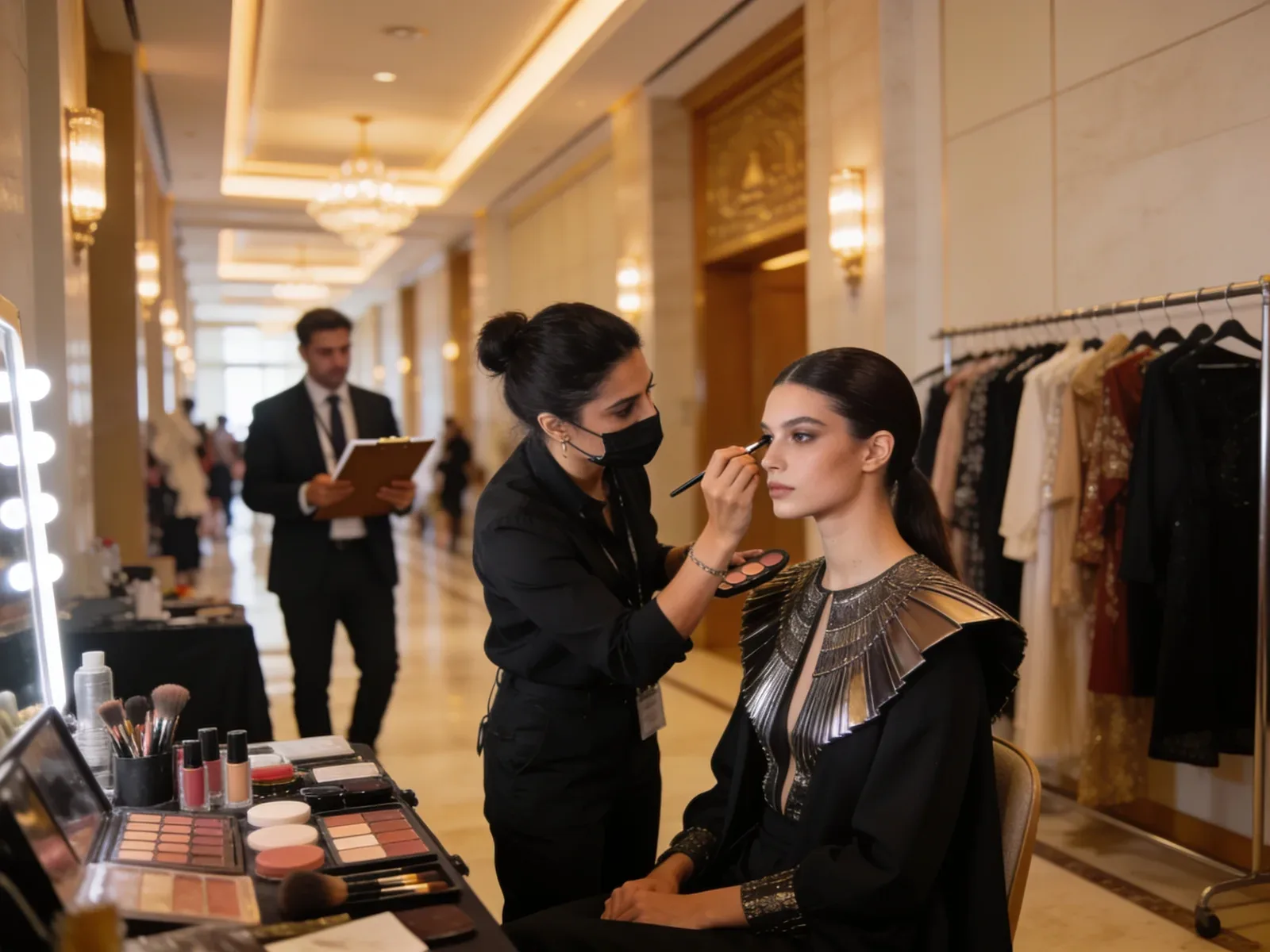
Hair and makeup integration requires scheduling that accounts for model count, look complexity, and station availability. Most Dubai fashion show venues provide limited backstage square footage relative to production scale. Confirm station numbers and power allocation during technical rehearsals, not on show day.
Communication protocols between agency representatives and production teams should be established before models arrive. Designate a single agency liaison with direct contact to the show producer, stage manager, and key hair and makeup leads. This prevents conflicting instructions during quick changes.
Backstage security badge quotas vary by venue and must be agreed case-by-case with facility management. DIFC venues, hotel ballrooms, and d3 spaces each operate distinct access control systems. Dressers, tailors, and personal assistants may require separate credentials from models. Unverified backstage capacity limits mean production teams should request maximum allowable support staff counts during initial venue negotiations.
Last-minute replacements within Dubai's tight talent network require pre-established contingency protocols. Maintain a reserve list of 2 to 3 alternates per key look, confirmed for availability but not formally booked. Local agencies can often activate these reserves within hours if permits are pre-cleared. International replacements are rarely feasible within 48 hours due to visa and permit timelines.
Climate control in backstage areas affects model performance directly. Dubai venues vary significantly in cooling capacity during load-in and show periods. Request HVAC scheduling that maintains stable temperatures from model arrival through final exit.
Next Steps for Organizers
Successful model booking in Dubai rewards systematic preparation over improvisation. Begin permit documentation before casting finalization. Confirm agency accreditation status with the UAE Media Council. Build cancellation penalties and usage buyout structures into production budgets from day one.
For organizers ready to move forward, book now to secure talent with verified permit clearance. Review your contract checklist against the updated Federal Decree-Law No. 25 of 2025 provisions. And verify that your selected venue's specific jurisdictional requirements align with your agency's permit processing capabilities.